CMS vs Custom Build: When to Stop Coding Your Own

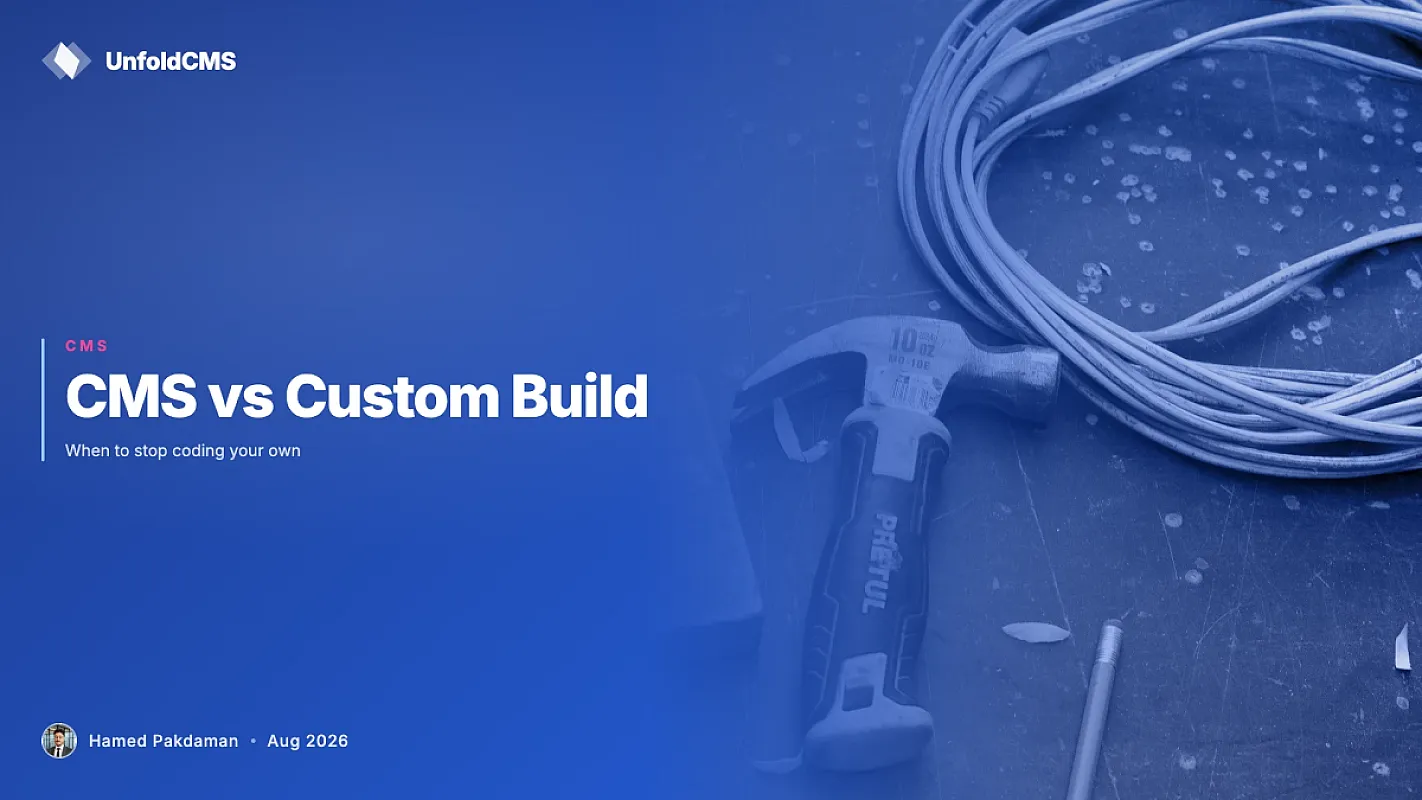
"We'll just build it ourselves" is the most expensive sentence in web development, and I say that as someone who did it on purpose. We spent over 18 months building UnfoldCMS. That experience is exactly why I can itemize what "a simple custom CMS" costs, and why the right answer for your project is probably not the one your inner engineer is whispering.
This post is the build-vs-buy decision for content management, argued with a builder's receipts.
TL;DR: Building custom content management makes sense in two cases: your content model is genuinely unlike anything a CMS ships (rare), or content is your product's core domain and differentiation (rarer). Everything else is faster and cheaper on an existing CMS, because the visible 20% (posts in a database, a form to edit them) hides the 80% you'll build for a year: media handling, roles, drafts, SEO plumbing, search, migrations, and an editor non-developers don't hate. A weekend prototype becomes a permanent second product.
The Prototype Lie
Every custom CMS starts the same way: a posts table, a Markdown field, an admin route with a form. Two days, works great, ship it. The team concludes content management was never that hard.
Then the requests arrive in their eternal order. An image in the post (now you need uploads, storage, resizing, and alt text). A draft the CEO can review (now you need statuses and preview URLs that work logged-out). A second author (roles). A typo fixed on mobile (your admin form isn't responsive). Schedule this for Tuesday (queues or cron, plus timezone bugs). "Why doesn't it look right on Google" (meta fields, OG tags, sitemaps, structured data). Each request is reasonable. Each is a week. None was in the two-day estimate.
I can be specific because we built all of it: media conversions, role systems, scheduled publishing, SEO fields with sane fallbacks, search, redirects, webhooks. That's what "over 18 months" means. Your custom build won't need all of it, but the subset it needs arrives on the roadmap whether you planned it or not.
What Each Path Actually Costs
The comparison people run in their head is "CMS license vs zero." The real ledger:
| Cost | Custom build | Existing CMS |
|---|---|---|
| Initial build | 3 to 12+ dev-months for production-grade | Hours to install, days to theme |
| The editor's experience | Whatever you build them (usually spartan) | The product's core competency |
| Security | Your team audits everything, forever | Vendor patches, framework protections |
| Feature requests | Your roadmap, your sprints | Ship with updates |
| Ongoing maintenance | A permanent internal product | Apply updates |
| Fit to weird requirements | Perfect, by definition | The honest limit |
A competent developer costs real money monthly. Three months of CMS-building is a five-figure spend before maintenance, against license costs that top out around $999 one-time in our pricing or $0 for open-source options plus hosting. The build only wins financially if it prevents years of fighting a mismatched tool, which brings us to when it does.
When Custom Genuinely Wins
Two cases survive the ledger, and I mean survive it, not flatter it.
Your content model is the product. A real-estate platform where "content" is listings with geodata, agent relations, and pricing engines. A recipe app with structured ingredients feeding a nutrition calculator. When the domain logic around content is the business, a general CMS becomes a fight, and frameworks (Laravel, Rails, Next.js with a database) are the right substrate. Notice this is an application with content in it, not a content site.
No CMS fits after honest evaluation. Key word honest: evaluated three, listed the gaps, the gaps are structural rather than cosmetic. This happens. It happens far less often than teams that enjoy building things report it happening.
There's also a legitimate middle path: headless CMS as your content backend, custom application around it. The CMS handles editing, media, and the API; your code handles the domain. Teams that "need custom" often need exactly this split, and it's what a CMS with a REST API is for.
The Question That Decides It
Strip the ledger and one question remains: is content management your differentiation, or your plumbing?
Plumbing means the blog, the marketing pages, the docs. Nobody chooses your product because the blog engine is bespoke. Buying (or self-hosting free) returns those dev-months to the product that does differentiate you. This is most projects, and the developers reading this mostly know it.
Differentiation means users pay you because of how content works in your product. Then build, without guilt, on a framework you love, and skip the CMS aisle entirely.
The failure mode worth naming: building custom because evaluating CMSs is boring and building is fun. I have deep sympathy. We turned that impulse into an actual product, which is the only version of the move that pays, and even then it took 18 months to earn back.
If the evaluation is where you are, our self-hosted CMS guide and the WordPress alternatives hub are working shortlists. Whatever you pick, insist on a real API and exportable data, so the custom option stays open the day you genuinely need it.
If You Build: The Minimum List That's Actually Minimum
For the two cases where building wins, here's the feature floor beneath which "custom CMS" means "future emergency," drawn from what we shipped first and what we regretted deferring.
Drafts and publish states can't be deferred; retrofitting them onto a live-writes-only system means migrating every consumer of the content. Same for slugs with history: the day marketing renames a post, either you built redirects or you shed the page's SEO. Media needs upload, storage abstraction (local now, S3 later without rewrites), and image sizing on day one, because editors will paste 8 MB photos into everything and no amount of asking stops them.
Auth needs roles even if today there are two users, because "everyone is admin" calcifies fast. And build the audit trail early (who changed what, when): it costs a model observer in Laravel, and it's the feature you can't reconstruct retroactively when you need it during an incident.
What you can genuinely defer: scheduling, workflows and approvals, localization, versioned rollback, API tokens for third parties, and search beyond SQL LIKE. Each earns its build when a real user asks twice.
Two framework notes from the trenches. Lean on the ecosystem's boring solutions (in Laravel: Sanctum for tokens, a mature media library package, framework validation) because every hand-rolled version of a solved problem is maintenance debt with your name on it. And write the content schema down before coding it; the two-day prototype's greatest damage is teaching the team that schema design can be improvised.
That's the honest floor: roughly the three months of the estimate table, before your domain features start. Which is the point.
FAQ
How long does it take to build a custom CMS?
A blog-shaped prototype: days. Production-grade with media, roles, drafts, scheduling, SEO plumbing, and an editor non-developers accept: three to twelve developer-months, then permanent maintenance. Teams reliably estimate the prototype and forget the rest.
Is it cheaper to build a CMS or use an existing one?
Existing, in nearly every case. Licenses run $0 (open source) to a few hundred dollars one-time; custom builds consume developer-months up front and a maintenance tax forever. Custom wins only when a mismatched CMS would cost years of workarounds.
Should I use a CMS or a framework like Laravel or Next.js?
For content sites (blogs, marketing, docs): a CMS. For applications with domain logic where content is one component: framework, possibly with a headless CMS handling the content slice. The split follows what your users are paying for.
What's the middle ground between CMS and custom build?
Headless: an existing CMS as the content backend (editing, media, API), your custom frontend and domain code around it. You skip building the editor and media pipeline while keeping full control of everything users see.
What stack should I build a custom CMS on?
The one your team maintains best. Laravel brings the deepest packaged ecosystem for content problems (auth, media, validation ship as mature packages); Next.js plus an ORM suits TypeScript-native teams; Rails remains excellent. The framework matters less than respecting the feature floor above.
Can I start custom and adopt a CMS later?
Yes, and it's the expensive direction: migrating hand-rolled content structures into a CMS's model means transforms plus URL preservation. Starting with a CMS and going custom later is cheaper because a good CMS's export path is a feature, not an afterthought.
Methodology
Build-effort figures come from our own development of UnfoldCMS (18+ months to production, feature list verifiable in the product) and from public build-in-public accounts of comparable projects. License pricing referenced from our pricing page and open-source project sites as of July 2026. We sell a CMS, so "don't build one" is convenient advice for us; the two build-anyway cases above are argued as strongly because they're where we'd land ourselves.
Free & Open Source
Own your CMS. No subscriptions.
Unfold CMS is free to download and self-host. Built on Laravel + React, full source code included.
Share this post: