CMS Performance Benchmarks: What to Test (2026)
A methodology guide for technical evaluators benchmarking CMS performance — what to measure, the 5 scenarios that matter, and how to compare fairly.
When to self-host, what it costs, and which CMS to pick — the 2026 guide.
WordPress is free, but production WordPress is not. The 5 hidden costs and the real 3-year TCO for small, mid-size, and enterprise sites.
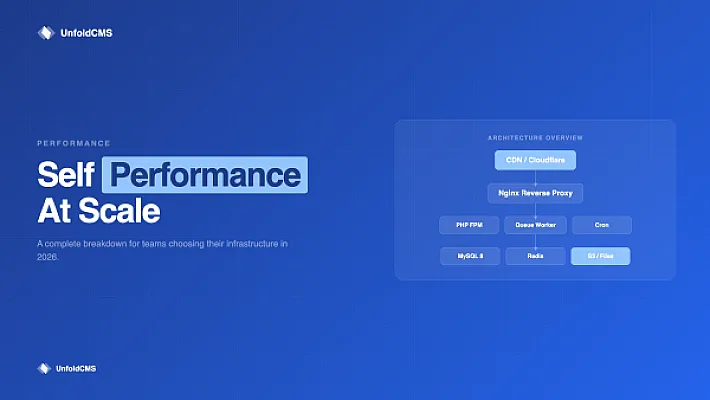
Why WordPress sites are slow in 2026 — the 5 main bottlenecks, how to diagnose each, what fixes actually work, and when switching CMSes is cheaper.
Every shadcn/ui component used in Unfold CMS, where it lives, and what we learned building 223 admin pages on top of the full shadcn surface area.
Laravel 12, React 19, Inertia 2, shadcn/ui, and Tailwind v4 — the modern Laravel CMS stack explained, layer by layer.
Most shadcn admin templates leave 80% of the CMS work to you — auth, permissions, media, publishing, SEO. Here's when a shadcn-native CMS makes more sense than a template plus weeks of glue code.
The first production CMS built entirely on shadcn/ui — 50 components, 183 admin pages, Tailwind v4, and three switchable themes. Here's why the shadcn philosophy maps perfectly onto what developers want from a CMS.
The 8 features developers should evaluate before choosing a CMS — from API design to local dev parity, migrations, and extensibility.
The honest tradeoffs between self-hosted and SaaS CMS platforms — data ownership, real costs, vendor lock-in, and a decision framework for teams.
A data-driven breakdown of the 7 pain points pushing developers away from WordPress in 2026 — from security nightmares to plugin bloat and ecosystem lock-in.
Plain-English explanation of headless CMS for developers who want to understand what makes it different from traditional platforms.